
How to Fertilize Flowering Bonsai
A beginner guide to healthy growth buds and better bloom preparation
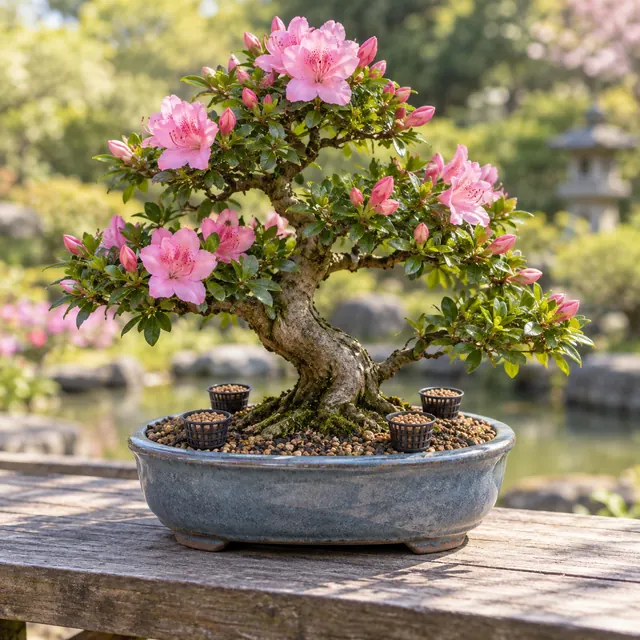
A flowering bonsai needs more than a fertilizer with a large middle number. It needs the correct light, season, pruning, water, health, and species-specific bloom cycle. Fertilizer supports that system; it cannot replace any of those conditions.
The beginner program uses Hanasaku as the primary fertilizer and MicroTotal as an occasional supplement. Before setting the schedule, determine whether the flowering tree is tropical or cold-hardy.
Flowering overlaps the other tree types
Flowering describes what the tree does, not the climate it lives in. Bougainvillea and some other flowering bonsai are tropical. Azalea, wisteria, flowering quince, crabapple, and cherry are generally cold-hardy. That distinction matters because the two groups do not share the same winter schedule.
Use Hanasaku as the primary fertilizer
Hanasaku is a Japanese organic pellet fertilizer with an analysis of 1.5-9-4.5. Its lower nitrogen relative to phosphorus and potassium makes it appropriate for a bloom-focused program that does not aim to push aggressive leafy growth.
- 1Confirm that the tree is healthy and actively growing.
- 2Use approximately 5 pellets for every 5 inches of pot width.
- 3Distribute the pellets across the soil or divide the measured amount among fertilizer cups.
- 4Water normally so water reaches the pellets.
- 5Follow the current package directions for reapplication. The current Bonsai Outlet guidance calls for applying Hanasaku every 3 to 4 weeks during the growing season.
Add MicroTotal on its own schedule
MicroTotal is a 5-0-0 liquid supplement containing nitrogen and supporting nutrients including iron, magnesium, sulfur, manganese, copper, zinc, and boron. It supplies no phosphorus or potassium, so it complements rather than replaces Hanasaku.
| Where the tree is growing | MicroTotal mixing rate | Timing |
|---|---|---|
| Indoor tropical flowering bonsai | 1 tablespoon per gallon of water | Every 6 to 8 weeks during active growth |
| Outdoor tropical flowering bonsai | 2 tablespoons per gallon of water | Every 6 to 8 weeks during active growth |
| Outdoor cold-hardy flowering bonsai | 2 tablespoons per gallon of water | Every 6 to 8 weeks during active growth and not during dormancy |
Use only enough mixed solution to water the pot normally. Apply MicroTotal on a different day from placing or refreshing Hanasaku pellets.
Feed through the bloom cycle
Before buds are visible
Build health during the species' normal active season. Use Hanasaku consistently rather than waiting until flowers are already open. A spring-blooming cold-hardy tree may have formed its flower buds during the previous growing season, so late fertilizer cannot replace lost buds.
When buds and flowers appear
Keep watering consistent and avoid unnecessary stress. Continue the product schedule if the tree remains active, but do not increase the dose to chase a larger display. Heavy root work, severe pruning, or repeated drying can shorten or disrupt flowering.
After flowering
Remove spent flowers when appropriate for the species and continue feeding while healthy growth continues. Check the species care sheet before pruning. Many spring-flowering woody plants set the next flower buds on growth made after the current bloom, so pruning at the wrong time can remove next year's display.
During rest or dormancy
Pause fertilizer when a tropical stops growing in weak winter light. Stop feeding a cold-hardy flowering bonsai as it enters dormancy. A fertilizer designed for flowers is still fertilizer; it is not needed by an inactive tree.
Why a flowering bonsai may not bloom
Poor flowering is often blamed on fertilizer because fertilizer is easy to change. In practice, several other conditions may control whether buds form and survive.
Hanasaku and other fertilizers
If flowering is the main goal, use Hanasaku as the primary fertilizer. Do not place Hanasaku, BioGold, and Bonsai Thrive on the same tree simply because all are available. They are different primary programs.
Uncle Bill's 3-3-3 can maintain a healthy flowering bonsai when you prefer a balanced liquid routine, especially when flowers are not the immediate goal. Bonsai Thrive is better suited to tropical growth and development than to a bloom-focused program.
Uncle Bill's 0-10-10 is not the same as Hanasaku. It contains no nitrogen and is not a complete primary fertilizer. Do not use it as a general bloom booster or as a reason to fertilize a dormant tree.
Common flowering questions
Should I fertilize while the tree is in full bloom?
If the tree is healthy and actively growing, continue the established program at the normal rate. Do not increase fertilizer during bloom. Stable watering and light are more important than a last-minute dose.
Can I make a bonsai flower by adding more phosphorus?
No fertilizer can guarantee flowers. Plants need phosphorus, but research does not support the idea that increasingly high phosphorus automatically produces more blooms. Confirm light, pruning, species, health, and season first.
Should a flowering tropical be fed in winter?
Only if it remains warm, receives strong light, and continues healthy growth. If growth slows or stops, pause fertilizer until it resumes.
Should a flowering azalea be fed in winter?
A cold-hardy azalea follows an outdoor seasonal cycle and should not receive routine fertilizer during dormancy. Use the cold-hardy guide for timing.
Can MicroTotal replace Hanasaku?
No. MicroTotal contains no phosphorus or potassium. It provides supporting nutrients and should be used with an appropriate primary fertilizer.
Can I fertilize after repotting?
Wait until the tree has recovered and resumed healthy growth. Flowering may be reduced after major root work because recovery takes priority.