
How to Fertilize a Bonsai Tree
A beginner guide to choosing a fertilizer and feeding with confidence
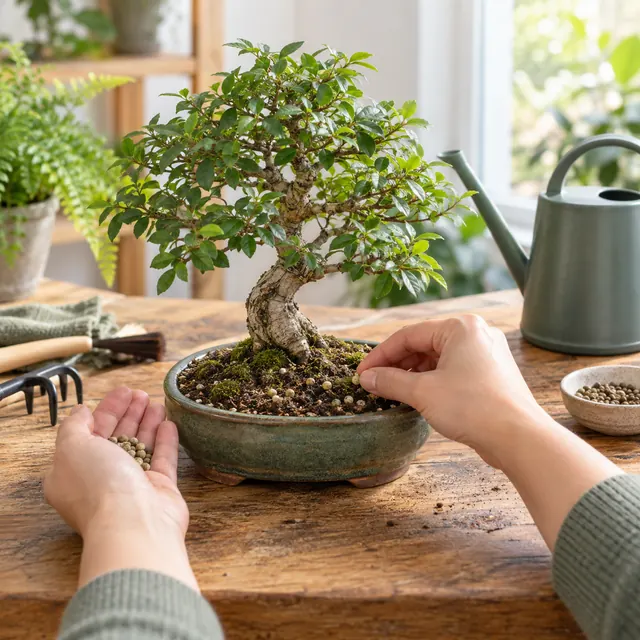
Fertilizing a bonsai does not have to begin with memorizing ratios or building a complicated calendar.
Begin by identifying the kind of tree you have and checking whether it is growing. Then choose one primary fertilizer that matches the tree and your goal.
If you remember only one rule, remember this: fertilize a healthy bonsai while it is actively growing.
Fertilizer supports growth. It cannot correct poor light, damaged roots, pests, or a watering problem.
The short answer
- Feed during active growth.
- New leaves, extending shoots, and normal water use are better signals than a date alone.
- Choose one primary fertilizer.
- Pellets provide a steady background feed. Liquid fertilizer gives you more control over individual applications.
- Follow the product rate.
- Bonsai pots vary in size, depth, soil, and watering frequency, so one universal scoop cannot fit every product.
- Pause when the tree is stressed.
- Wait after shipping, repotting, severe pruning, pest problems, or root trouble until healthy growth returns.
Start with the tree
A beginner usually needs to answer two questions before buying fertilizer.
- 1Is the tree tropical or cold-hardy? Tropical bonsai may continue growing indoors when light and warmth are adequate. Cold-hardy bonsai follow an outdoor seasonal cycle and rest during winter.
- 2What is the goal? A developing tree may need stronger growth. A refined tree may need gentler maintenance. A flowering tree needs a program that supports health without pushing unnecessary leafy growth.
Flowering is not a third climate category. An azalea may be a cold-hardy flowering bonsai, while a bougainvillea is a tropical flowering bonsai. The tropical or cold-hardy classification tells you when to feed. The flowering goal helps you choose what to feed.
What fertilizer does
A bonsai grows in a small amount of soil and is watered thoroughly and often. Water moving through a container can carry soluble nutrients out with it, so the tree eventually needs those nutrients replaced. Fertilizer supplies raw materials the tree can use while it is already carrying out normal growth.
Fertilizer is not plant medicine. Adding more will not repair roots that cannot absorb water, create light that is not available, or cure insects and disease. When a tree looks weak, confirm light, watering, drainage, temperature, and pests before assuming it needs food.
What the three numbers mean
Every fertilizer displays three numbers in the same order: nitrogen, phosphorus, and potassium. The numbers are percentages by weight, not a rating of product quality.
- Nitrogensupports leaves, stems, chlorophyll, and vegetative growth.
- Phosphorussupports energy transfer and is involved in roots, flowers, and fruit.
- Potassiumsupports water regulation, strength, and many normal plant functions.
All three nutrients matter. A higher middle number does not automatically create more flowers, and a high first number is not always better. The useful ratio depends on the species, season, and whether the goal is development, refinement, or flowering.
Choose one primary fertilizer
A primary fertilizer supplies the main feeding program. Beginners usually get better results from one understandable routine than from layering several products without knowing why.
| Tree or goal | Primary fertilizer | Why it fits |
|---|---|---|
| Tropical bonsai or a tree being developed | Bonsai Thrive 180 19-5-9 |
Long-lasting granular feeding for stronger growth, foliage, and development |
| Cold-hardy or refined outdoor bonsai | BioGold 3.5-3.7-3.3 |
Gentle organic pellets for steady seasonal feeding |
| Flowering bonsai | Hanasaku 1.5-9-4.5 |
Pellet fertilizer selected for a bloom-focused program |
| A simple liquid-only routine | Uncle Bill's Liquid Bonsai Brew 3-3-3 |
A balanced low-dose liquid that is easy to mix and apply |
MicroTotal has a different job
MicroTotal is a concentrated 5-0-0 liquid supplement. It supplies nitrogen along with iron, magnesium, sulfur, manganese, copper, zinc, and boron. It does not contain phosphorus or potassium, so it does not replace a complete primary fertilizer.
The beginner approach is simple: choose one primary fertilizer, then use MicroTotal every 6 to 8 weeks during active growth when the program calls for additional micronutrient support. Use 1 tablespoon per gallon for indoor tropical bonsai and 2 tablespoons per gallon for outdoor bonsai. Apply only enough mixed solution to water the pot normally.
How to apply fertilizer safely
- 1Check the tree. Look for new leaves, extending shoots, healthy foliage, and normal drying between waterings.
- 2Check the soil. If the soil is bone dry, moisten it first. Do not pour concentrated fertilizer onto dry, stressed roots.
- 3Measure the product. Use the current package directions for that fertilizer. Do not substitute a rate from a different product.
- 4Apply evenly. Spread pellets around the pot or divide them among fertilizer baskets. Apply liquid across the soil until water drains normally.
- 5Keep the normal watering routine. Pellet fertilizer releases as the tree is watered. A gallon is a mixing ratio, not the amount one bonsai must receive.
- 6Record the date. A calendar reminder prevents forgotten or duplicated applications.
Simple starting routines
When to wait
- ✕The tree just arrived and has not settled into its new light and watering routine.
- ✕The tree was recently repotted, root-pruned, or heavily styled and has not resumed healthy growth.
- ✕Leaves are wilting, dropping rapidly, scorched, or showing an unresolved pest problem.
- ✕Water sits on the soil or runs around a dry root ball instead of moving through it normally.
- ✕A cold-hardy bonsai is dormant, even if it is an evergreen that still has needles or foliage.
- ✕An indoor tropical has stopped growing because winter light is too weak.
There is no universal number of days to wait after repotting. Recovery depends on the species, season, amount of root work, temperature, and aftercare. Resume feeding when the tree is stable and healthy growth has returned.
Common beginner questions
Can fertilizer save a sick bonsai?
Usually not. Diagnose watering, drainage, light, temperature, roots, and pests first. Fertilizer is useful when a functioning tree is ready to grow.
Should I use pellets and liquid fertilizer together?
It can be done, but a beginner does not need to stack products. Start with one primary fertilizer. Add MicroTotal only on its separate schedule, and add another complete fertilizer only when you have a clear reason.
Is organic fertilizer better?
Not automatically. Organic pellets like BioGold and Hanasaku release nutrients gradually as they are watered, which makes them gentle and forgiving. Some organic fertilizers also have a noticeable smell, so keep that in mind for a tree that lives indoors. A slow-release granular fertilizer like Bonsai Thrive suits tropical trees and trees you want to grow more strongly. Choose the fertilizer that fits your tree and goal, then use it consistently.
Do I fertilize every time I water?
No. Water whenever the tree needs water. Apply fertilizer only at the product's stated interval. Most waterings will be plain water.
How often should I fertilize my bonsai?
It depends on the fertilizer, so follow the product rather than a fixed calendar. Bonsai Thrive feeds for up to 180 days, BioGold is refreshed about every two months, Hanasaku every 3 to 4 weeks, and Uncle Bill's 3-3-3 about every two weeks. MicroTotal runs on its own 6 to 8 week schedule. Feed only while the tree is actively growing.
Do I fertilize in winter?
Do not fertilize dormant cold-hardy bonsai. A tropical bonsai may be fed in winter only if it remains warm, receives strong light, and continues producing healthy growth.
Does yellow foliage always mean a nutrient deficiency?
No. Yellow leaves can result from watering trouble, weak light, normal seasonal change, damaged roots, pests, or nutrient availability. Check the whole growing situation before adding fertilizer.
Do I need 0-10-10?
Most beginners do not need it as part of a core feeding program. It is a specialized nitrogen-free product for a deliberate late-season plan, not a complete everyday fertilizer and not a reason to feed a dormant tree all winter.