
How to Fertilize Tropical Bonsai
A simple seasonal guide for indoor and outdoor tropical trees
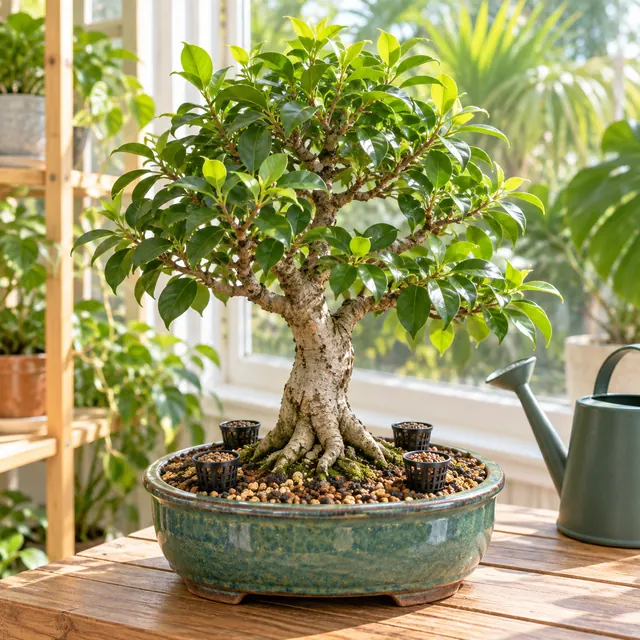
Tropical bonsai do not follow the same winter schedule as maples, pines, and other cold-hardy trees.
A tropical can continue growing indoors, but only when light, warmth, water, and root health support that growth. The tree's behavior matters more than the month on the calendar.
The easiest beginner routine uses Bonsai Thrive 180 as the long-lasting primary fertilizer and MicroTotal as an occasional supplement. Reusable fertilizer baskets keep the pellets contained and make the routine easy to see.
First confirm that the tree is tropical
Common tropical and subtropical bonsai include ficus, dwarf jade, schefflera, Fukien tea, and Brazilian rain tree. These trees need protection from cold temperatures. Many spend summer outdoors and move inside before cold weather arrives.
A tree sold as an indoor bonsai is not automatically growing every day of the year. Indoor growth may slow when days shorten, light levels drop, or the tree adjusts to a new location. Feed the growth you can see rather than feeding simply because the plant is inside.
- ✓New leaves are opening
- ✓Shoot tips are extending
- ✓Foliage looks healthy
- ✓Soil drains and dries normally
- ✕Just arrived or was repotted
- ✕Wilting, dropping leaves, or pests
- ✕No new growth in low winter light
- ✕Soil is bone dry
The two part tropical feeding program
This program separates the jobs of the two products. Bonsai Thrive provides the primary supply of nitrogen, phosphorus, and potassium over a long period. MicroTotal provides additional nitrogen and supporting nutrients every 6 to 8 weeks. MicroTotal is not a replacement for the primary fertilizer.
Use Bonsai Thrive 180
Bonsai Thrive 180 is a 19-5-9 slow-release granular fertilizer used when the goal is healthy foliage, branch extension, trunk development, or stronger overall growth. It is especially practical for tropical bonsai and trees in development.
- 1Fill each small fertilizer basket completely with Bonsai Thrive and close the lid.
- 2Place the baskets evenly around the pot so normal watering reaches them.
- 3Use 2 baskets for a 5 to 6 inch pot, 3 baskets for a 7 to 9 inch pot, and 4 baskets for a 10 to 12 inch pot.
- 4Water the tree normally. One application feeds for up to 180 days.
- 5Do not refill the baskets after a few weeks or when MicroTotal is due. Replace or refill only when the 180-day feeding period has ended and the tree is still actively growing.
Add MicroTotal
MicroTotal is a 5-0-0 liquid supplement that provides nitrogen, iron, magnesium, sulfur, manganese, copper, zinc, and boron. It contains no phosphorus or potassium. Its purpose is to add supporting nutrients that may not be supplied in sufficient amounts by a primary fertilizer or fast-draining bonsai soil alone.
- Indoor tropical bonsai
- Mix 1 tablespoon per gallon of water.
- Outdoor tropical bonsai
- Mix 2 tablespoons per gallon of water.
- Application interval
- Apply every 6 to 8 weeks while healthy growth continues.
Use only enough mixed solution to water the pot normally and allow excess water to drain. You do not need to pour the entire gallon into one bonsai. Apply MicroTotal on a different day from placing or refilling the Bonsai Thrive baskets.
Choose one primary plan
Bonsai Thrive is not the only way to feed a tropical bonsai. Some owners prefer a liquid-only routine or need a flowering program. Choose the plan that matches your goal; do not use every primary fertilizer together.
| Goal | Primary fertilizer | MicroTotal |
|---|---|---|
| Stronger growth or development | Bonsai Thrive 180 | Every 6 to 8 weeks during active growth |
| Gentle liquid-only maintenance | Uncle Bill's 3-3-3 mixed at 1 tablespoon per gallon, generally every two weeks during active growth | Optional on its separate 6 to 8 week schedule |
| Flowers are the main goal | Hanasaku pellets | Every 6 to 8 weeks during active growth |
For a beginner, the cleanest choice is either Bonsai Thrive or Uncle Bill's 3-3-3 as the primary program. Do not automatically add 3-3-3 between Thrive applications. Add another complete fertilizer only when you have a clear reason and understand the total feeding program.
How the season changes the routine
Spring and increasing light
Resume or begin feeding when new leaves open and shoots extend. A tropical that has been resting in low winter light may need time to restart. Do not force the calendar. Wait for healthy growth.
Summer outdoors
Warmth and bright outdoor light often produce the strongest growth of the year. Continue the chosen program and water according to the tree's needs. Hot weather may make the pot dry faster, but faster watering does not mean fertilizer should be applied more often than directed.
Fall transition indoors
Moving indoors changes light, temperature, airflow, and water use. Watch the tree for a few weeks. If new growth continues under a bright window or grow light, continue the program. If growth slows or stops, pause MicroTotal and do not refill Bonsai Thrive baskets until active growth returns.
Winter indoors
Warmth alone does not prove that the tree needs fertilizer. A tropical under strong supplemental light may keep growing and can continue to be fed. A tropical in weak winter light often rests or grows very slowly and should receive little or no fertilizer. Excess fertilizer during slow growth can accumulate in the soil and damage roots.
Newly purchased and recently repotted trees
Do not fertilize a newly arrived tree automatically. First establish the correct location and watering rhythm. If the tree arrived healthy and continues growing, it can enter the feeding program. If it drops leaves or stops growing while adjusting, wait.
After repotting, allow the root system to recover. There is no single waiting period that fits every tropical. Resume fertilizer when the tree is stable, water moves through the soil normally, and healthy new growth has returned.
Common tropical feeding problems
The baskets are still full after several weeks?
That can be normal. Bonsai Thrive is designed to release over a long period. Water must reach the baskets, but the granules do not need to disappear quickly to be working.
The tree moved indoors and dropped leaves?
Pause fertilizer while you check light, temperature, drafts, watering, and pests. Leaf drop after a move is not an instruction to add more food.
The soil dries much more slowly indoors?
Water less often, based on the soil, but do not change the fertilizer concentration. Slower drying is a sign that the tree may also be growing more slowly.
The tree is flowering?
Use the flowering guide. If flowers are the goal, Hanasaku may be a better primary fertilizer than Bonsai Thrive. The tree is still tropical, so the active-growth rule and indoor-versus-outdoor MicroTotal rate still apply.
The leaves are yellow?
Check light, watering, roots, pests, and normal leaf turnover before assuming a deficiency. MicroTotal supplies iron and other supporting nutrients, but it cannot correct roots that are unhealthy or a pot that remains waterlogged.