
How to Fertilize Cold Hardy Bonsai
A seasonal guide for outdoor deciduous trees and conifers
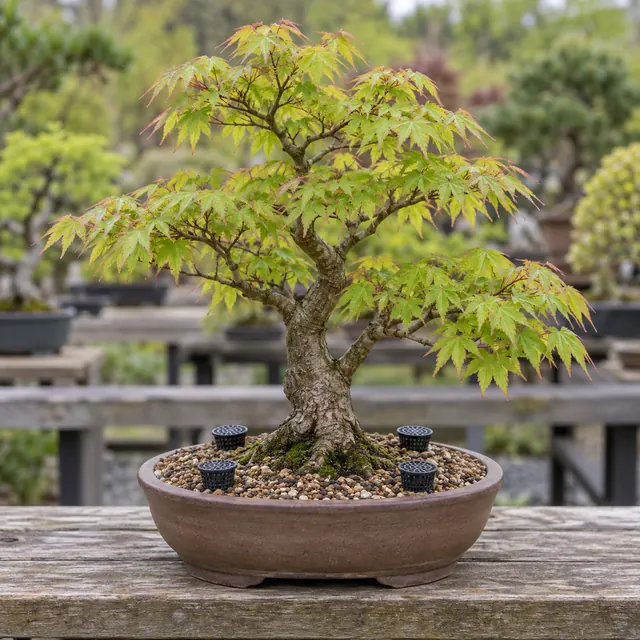
Cold-hardy bonsai live by the outdoor growing season. Maples, elms, hornbeams, junipers, pines, crabapples, and many other temperate species grow in spring and summer, prepare for cold weather in fall, and rest during winter. Their feeding program should follow that cycle.
The beginner program uses BioGold for steady primary nutrition and MicroTotal for periodic supporting nutrients. Four reusable fertilizer cups keep BioGold organized on the soil surface.
Cold-hardy means seasonal
A cold-hardy bonsai is not an indoor houseplant. It normally needs outdoor light, weather, and a species-appropriate winter rest. Keeping green needles does not mean a juniper or pine is actively growing all winter. Evergreens continue some plant functions, but they still follow a seasonal growth and dormancy pattern.
Use visible growth, local weather, and the species care sheet together. Spring does not arrive on the same date in Massachusetts, Georgia, and Colorado, and different species begin and finish growth at different times.
The BioGold and MicroTotal program
Use BioGold as the primary fertilizer
BioGold is an imported organic pellet fertilizer with an analysis of approximately 3.5-3.7-3.3. It supplies a gentle, steady feed that suits many established, refined, and cold-hardy outdoor bonsai without aggressively pushing soft growth.
- 1Begin after the tree has entered active spring growth. Look for opening buds, extending shoots, or new needles.
- 2Use approximately 5 pellets for every 5 inches of pot width.
- 3Distribute the pellets around the soil surface or divide them among the four fertilizer cups.
- 4Water normally so water reaches the pellets.
- 5Refresh BioGold after about two months while active growth continues. Heat, watering, and weather can affect how quickly organic pellets break down.
Add MicroTotal during active growth
MicroTotal is a concentrated 5-0-0 liquid supplement. It adds nitrogen, iron, magnesium, sulfur, manganese, copper, zinc, and boron. Because it contains no phosphorus or potassium, it supports but does not replace BioGold.
- Mixing rate
- Use 2 tablespoons per gallon of water for an outdoor cold-hardy bonsai.
- Timing
- Apply every 6 to 8 weeks while the tree is healthy and actively growing.
- Amount for one tree
- Use only enough mixed solution to water the pot normally. The full gallon can be shared among several trees.
- Scheduling
- Apply MicroTotal on a different day from placing or refreshing BioGold.
The seasonal schedule
Spring growth
Wait until the tree has clearly started growing. Then place BioGold and begin the MicroTotal interval. A recently repotted tree should recover and resume healthy growth before it is fertilized.
Early and midsummer
Continue steady feeding while growth remains healthy. Refresh BioGold at its normal interval and use MicroTotal every 6 to 8 weeks. Do not increase the rate simply because hot weather requires more frequent watering.
Late summer and fall
Watch growth rather than using one nationwide cutoff date. As shoots stop extending and the tree begins preparing for dormancy, stop routine feeding and avoid encouraging a flush of tender growth that may not harden before cold weather. Remove spent pellets or cups when the feeding program ends.
Winter dormancy
Do not fertilize a dormant cold-hardy bonsai. Winter care should focus on protecting the roots appropriately for the species and climate and preventing the soil from becoming completely dry. Fertilizer left in a cold, inactive root zone does not replace proper winter protection.
Deciduous trees and conifers
Deciduous bonsai make the seasonal change easy to see because leaves color and fall. Stop feeding as growth slows and dormancy approaches.
Conifers can confuse beginners because they keep needles or scale-like foliage. A juniper that is still green in January is not necessarily growing. Follow its outdoor seasonal cycle, not the presence of foliage alone. Begin feeding again when spring growth becomes active.
Refined trees often need steady maintenance rather than maximum extension. BioGold is well suited to that purpose. Young material being developed may be fed more assertively by experienced growers, but the BioGold and MicroTotal routine is a clear, conservative place for a beginner to start.
The limited role of 0-10-10
Uncle Bill's 0-10-10 contains phosphorus and potassium but no nitrogen. It is not a complete everyday fertilizer and it is not part of the core cold-hardy bundle. Most beginners do not need to add it to a BioGold and MicroTotal program.
Some growers use a nitrogen-free product as part of a deliberate late-season plan while a tree is still physiologically active. That does not mean a dormant bonsai should be fed throughout winter. If you use 0-10-10, know the purpose, follow the current label, and do not use it as a rescue treatment for a stressed or recently root-pruned tree.
Common cold hardy feeding problems
The tree has not opened buds yet?
Wait. The date may say spring, but the tree has not entered the feeding period. Confirm that winter protection, moisture, and temperatures are appropriate.
The BioGold pellets are soft or changing shape?
Organic pellets break down as they are watered. Keep the normal watering routine and refresh them according to the product interval rather than waiting for every piece to disappear.
A juniper is green in winter?
Green foliage is normal for an evergreen and does not prove active growth. Do not apply routine fertilizer during winter dormancy.
The tree was repotted this spring?
Wait until the tree has stabilized and resumed healthy growth. The amount of root work, species, and weather matter more than a fixed number of days.
The tree looks weak in late summer?
Do not assume fertilizer is the answer. Check heat stress, water, drainage, pests, roots, and species-specific behavior before feeding.